


300 doors a week: CT Project canvassers engage working class people across the state
Rather than selling products, seeking donations or promoting political candidates, canvassers with The Connecticut Project have a different goal: building relationships with working class residents across the state and encouraging them to advocate for policies affecting their lives.
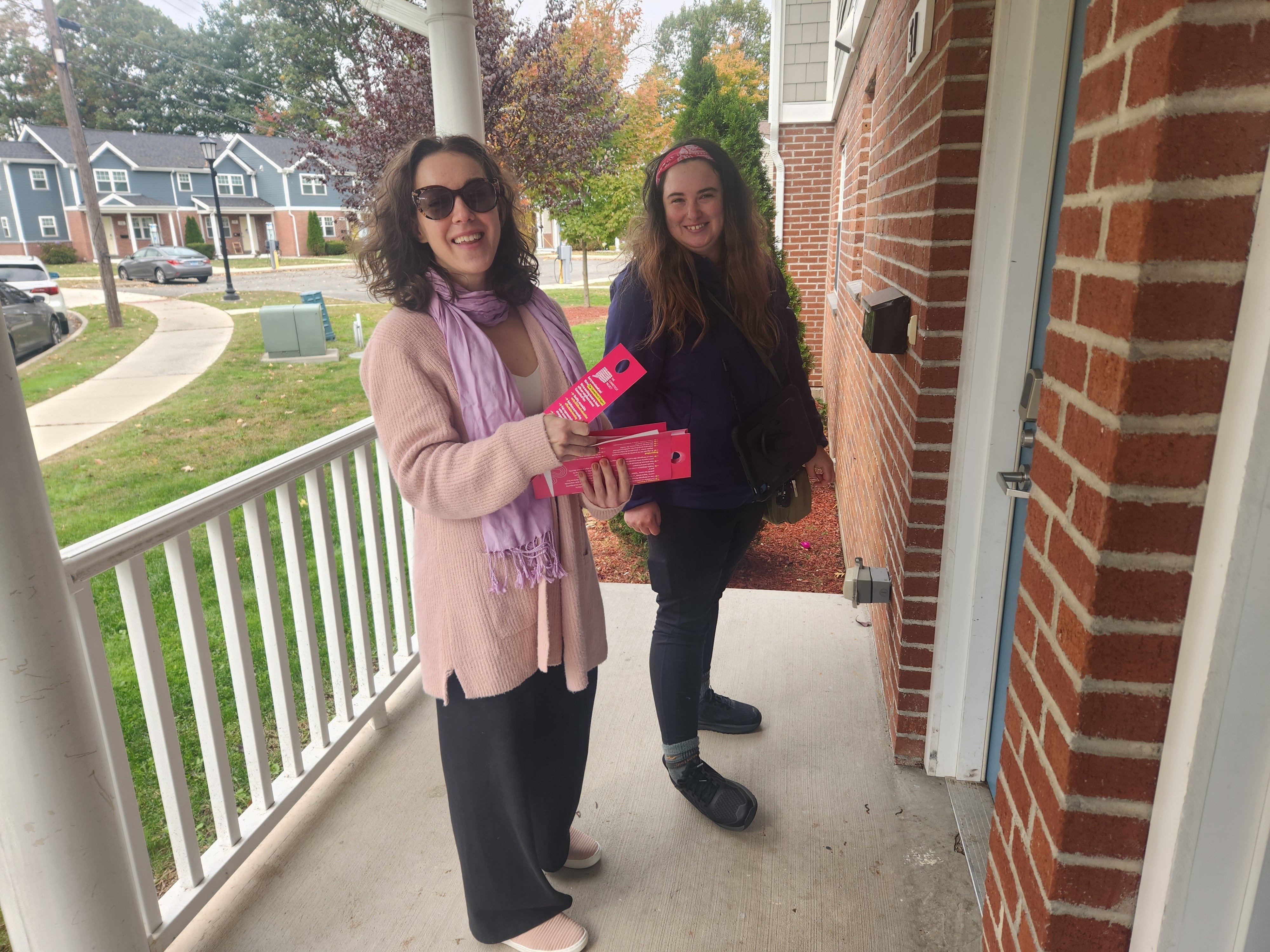
More than two dozen residents gathered at the Meriden Public Library on a recent autumn Saturday, preparing to spend the morning knocking on doors – some for the first time.
In groups of three and four, the canvassers headed into several working class neighborhoods to talk with people about a proposed refundable state tax credit for Connecticut renters that advocates hope state lawmakers will consider during the 2027 legislative session. Depending on their income, eligible renters could receive between $500 and $2,500.
A recent Wesleyan SurveyLab poll found 73% of self-identified registered voters support such a tax credit for low- to middle-income renters. A bill creating the credit failed last year.
“We know that this will help pay next month’s rent, put aside money for emergencies, pay for that high gas bill that’s always going up, stuff like that. Would that make a difference in your life?” Hillary Desideraggio, a field organizer with The Connecticut Project, asked a woman named Lizvel.
“It would,” she replied with a laugh.
“Yeah, a lot of people say that, because costs are high right now and they’re only going up,” Desideraggio said.
Lizvel agreed to sign a petition supporting the proposal and meet Desideraggio later for coffee to talk more about the renter's tax credit and other renter-related issues The Connecticut Project plans to pursue during the upcoming session.
Similar conversations take place thousands of times each week across Connecticut. They involve both paid canvassers and volunteers working with The Connecticut Project.
The nonprofit, nonpartisan organization employs 25 full-time canvassers who each knock on roughly 300 doors a week in about a dozen midsize cities. A separate phone team conducts similar outreach, while volunteers supplement both efforts, often contacting residents during evenings and weekends as part of "community canvasses.”
Rather than selling products, seeking donations or promoting political candidates, canvassers with The Connecticut Project have a different goal: building relationships with working class residents across the state and encouraging them to advocate for policies affecting their lives.
“I want them to not just say, ‘I’ll sign the petition and have someone else do the work for me,’” Desideraggio said. “I want them to be like, ‘oh, this will only happen if I step in and do what I can.’”
The Connecticut Project, she said, is offering them a way to get involved.
“I think there’s a lot of people that are sitting at home going, ‘man, I don’t like what’s happening. I have no idea what to do,’” Desideraggio said. “So when someone comes to them and says, ‘I have something specific that you can do,’ they’re like, ‘oh, you’re not just going to tell me to just go figure it out myself? You have a task for me?’ People love tasks. They love accomplishing things.”
Founded in 2021, The Connecticut Project launched its canvassing operation two years ago, beginning in Waterbury and New Britain, before expanding into about 10 more midsize cities. Mathias Burner, the organization's director of engagement, said The Connecticut Project concentrates on communities where other groups have not historically maintained a significant organizing presence, rather than duplicating efforts in larger cities like Bridgeport, Hartford, and New Haven.
In-person canvassing is also done in Meriden, Middletown, East Hartford, Manchester, Ansonia, Derby, Seymour, Shelton, Naugatuck, and Bristol while the phone team reaches out to residents in other Connecticut communities.
The Connecticut Project’s paid canvassers are assigned to specific regions, allowing them to develop relationships with residents over time. Those relationships, Burner said, are intended to encourage working class people to become involved in their communities, often for the first time.
“It’s really hard when the space is only made for certain folks,” Burner said of community organizing. “I think we need to get more people involved in politics, right? We need to get more people involved in community organizing.”
Burner said he’s not aware of any other groups in Connecticut doing the same general advocacy and organizing canvassing work on the scale of The Connecticut Project, especially with a focus on the working class population. He said there’s been less investment over the past five to 10 years in door knocking and canvassing, replaced by more digital outreach.
“That conversation of someone showing up on your doorstep, talking for 10, 15 minutes about what’s important to you, there’s a real connection point there that I would hate to miss,” Burner said.
In the early days, canvassers went door-to-door in working class neighborhoods asking residents about their top concerns, particularly affordability, which Burner described as a “bread and butter” issue for The Connecticut Project. The organization, he said, wanted to understand the financial pressures facing working class residents, from housing costs to health care.
Burner said that feedback has helped shape the organization's priorities and continues to inform its work. Various teams use the information to identify potential solutions, whether through legislation, changes in state policies, public awareness campaigns, or philanthropy.
The names of people who sign The Connecticut Project’s petitions, such as the one supporting the renter’s tax credit, are also used to show state lawmakers how many people in their districts support the proposed legislation.
Burner said the organization measures its success not only by the number of doors knocked, conversations held and petitions signed, but also by how many residents become more deeply involved. That includes continued engagement afterward, such as testifying at the state Capitol on various bills, and even participation in leadership training programs sponsored by The Connecticut Project.
For some residents, an initial conversation at the front door or a response to online outreach has become a first step toward more sustained community involvement.
Hayley Solak, a volunteer from Durham, first found out about The Connecticut Project's efforts to pass a renter’s tax credit last year. After struggling to find affordable housing following a divorce, she signed a petition and eventually met for coffee with Desideraggio, who encouraged her to enroll in a community leadership training program sponsored by the organization.
She’s now midway through the program.
“Sometimes it’s easier for me if somebody shows me something that they’re doing, that I can be involved in, to get started,” Solak said. “Then, that’s going to eventually inspire me to branch out.”
For April Velsor of Meriden, a first-time volunteer with The Connecticut Project, housing affordability is a personal issue.
“I’ve been homeless before and recently my landlord went up $200 on rent and I’m the only one with income in the family, so it hurts. It hurts the pocketbook,” she said.
Velsor recently came across The Connecticut Project's online petition supporting the renter's tax credit. She signed it because she cared about the issue and was later contacted by the organization and invited to the gathering in Meriden.
She didn't realize she'd be knocking on doors until she arrived at the library.
“I didn’t know we were going to go door-to-door, so it was just a new process. It was fun though,” she said. “It was a good experience.”
Burner said making canvassing welcoming and accessible to first-time volunteers is an important part of The Connecticut Project's efforts to encourage more people to become involved in their communities, especially at a time when many may feel overwhelmed or discouraged.
“I think we’re trying to be the greatest foe of apathy,” he said. “I think it’s really easy to be apathetic. The world is overwhelming. There’s a lot of different things to work on.”
The ultimate measure of success of The Connecticut Project’s canvassing work, he said, goes beyond the passage of any particular piece of legislation.
“If you got 10 people in your neighborhood to care more about your neighborhood specifically, right? Like I think that's generally for a net good,” he said.
His hope is that The Connecticut Project's organizing efforts will endure long after it’s gone and the volunteers become organizers themselves, people invested in what’s happening in Connecticut and their city or town.
“It’s kind of like an organizing cliché,” he said. “You should always be organizing yourself out of a job, right?”